Enterprise Astronomy
~Deep Space Images by Annie Morris~
I clearly do not blog often. I might have a whim every few years, but that's likely to be it. Enjoy the few I have written:
A Whale of a time getting to the Elephant Trunk
As those of you who know me probably know, I prefer nebulas to galaxies. No real reason, I just do. Not that I dislike galaxies but I enjoy imaging nebulae a lot more. So as galaxy season goes into full swing what do I pick for an object to image: the Elephant Trunk Nebula!! Being at a nice northern latitude I am day by day getting less "dark" to work with not to mention the infamous cloudy skies of England so when I saw on the forecast that I was supposed to get not one, but two perfect nights in a row I set up my scope and accepted the fact that I wouldn't sleep from Friday morning until Sunday night.
I have been looking forward to doing Elephant Trunk in narrowband since I started imaging, I just had to wait until I was good enough and I finally got SII and OIII filters. Of course, the Elephant Trunk doesn't rise high enough for me to begin imaging it until about 1257am so I had to come up with something to image as a warm-up. I was randomly slewing about while trying to decide and landed on the "Whale Galaxy" and figured, why not? Off I went on my imaging marathon.
Night 1 I imaged for 5 hrs on the Whale, mostly on luminance but a little red and blue binned as well and then switched to narrowband filters and moved on over to the Elephant Trunk and continued on until sunrise.
Night 2, same except I shot more luminance and a little red, blue, and evened out the green on the Whale followed by Hydrogen-Alpha only on Elephant Trunk.
It is now 55 hrs, give or take, since I last slept (although I did take a couple of quick naps when my daughter did during the day) but my marathon weekend is complete! I spent around 4 hrs processing today and have my final results.
First, the Whale Galaxy (and his companion), total LRGB integration time: 7 hrs (4:1:1:1)

and finally my Elephant Trunk in HST-mapped narrowband (SII, Ha, OIII). Total integration time: 10hrs (2:6:2), (I had a couple of hours of Ha from a week or two ago that I added in to this weekends data):

Astrophotography with a bright moon
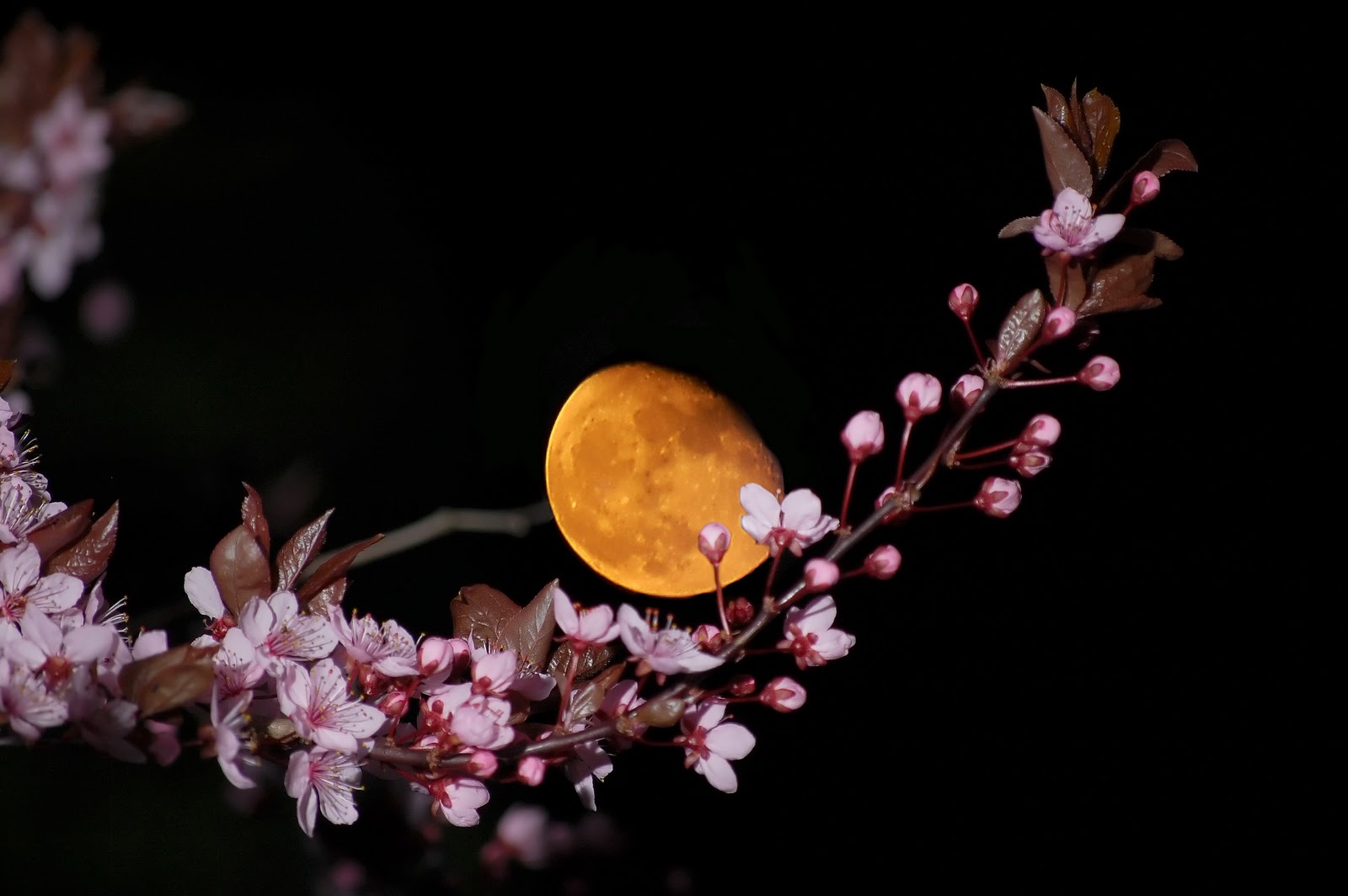
Every month astrophotographers cringe at two words "full moon" as the great glowing orb in the sky makes it very difficult to image. Narrowband or photographing the moon are the two main options if you want to take advantage, as I do, of the few clear nights I get (even if it falls on a full or near-full moon). A few days past the full moon this month I noticed the moon rising with a beautiful orange color. I realized that it would pass right by the tree in my front yard where the cherry blossoms are currently blooming so I popped out with my camera to catch it.
This is a combination of two photos, taken at the same exposure but different focuses then merged so both the moon and the cherry blossoms would be in focus in the final product. The tree was lit up by an off camera flash, hand-held the lower left of the camera and set to fire at the last moment of exposure.
First Bicolor Narrowband Image
I have imaged various objects in just Ha before, but just got to use my OIII filter for the first time and am attempting my first bi-color processing. I am hoping to get more hours of both Ha and OIII in the coming days or weeks (whatever the weather will allow).
This is 3 hrs of Ha and an hour of OIII (yes I need more, I have trees which are preventing me from imaging this target for too long in any one night).
I think I have a method (albeit convoluted) that gets a result I like. Basically I have combined portions of all the various bicolor processing techniques I found. A little of Cannistra's, a little of JPM's tone-mapping, a little of my own mixture and PS actions and alot of layers and masks. For only 6 hrs of data (3hrs each of Ha and OIII) I think I have pulled out a good bit of detail and data, at least enough to make make me happy. I also found a balance of colors that I like (although I know with NB this is basically personal preference).
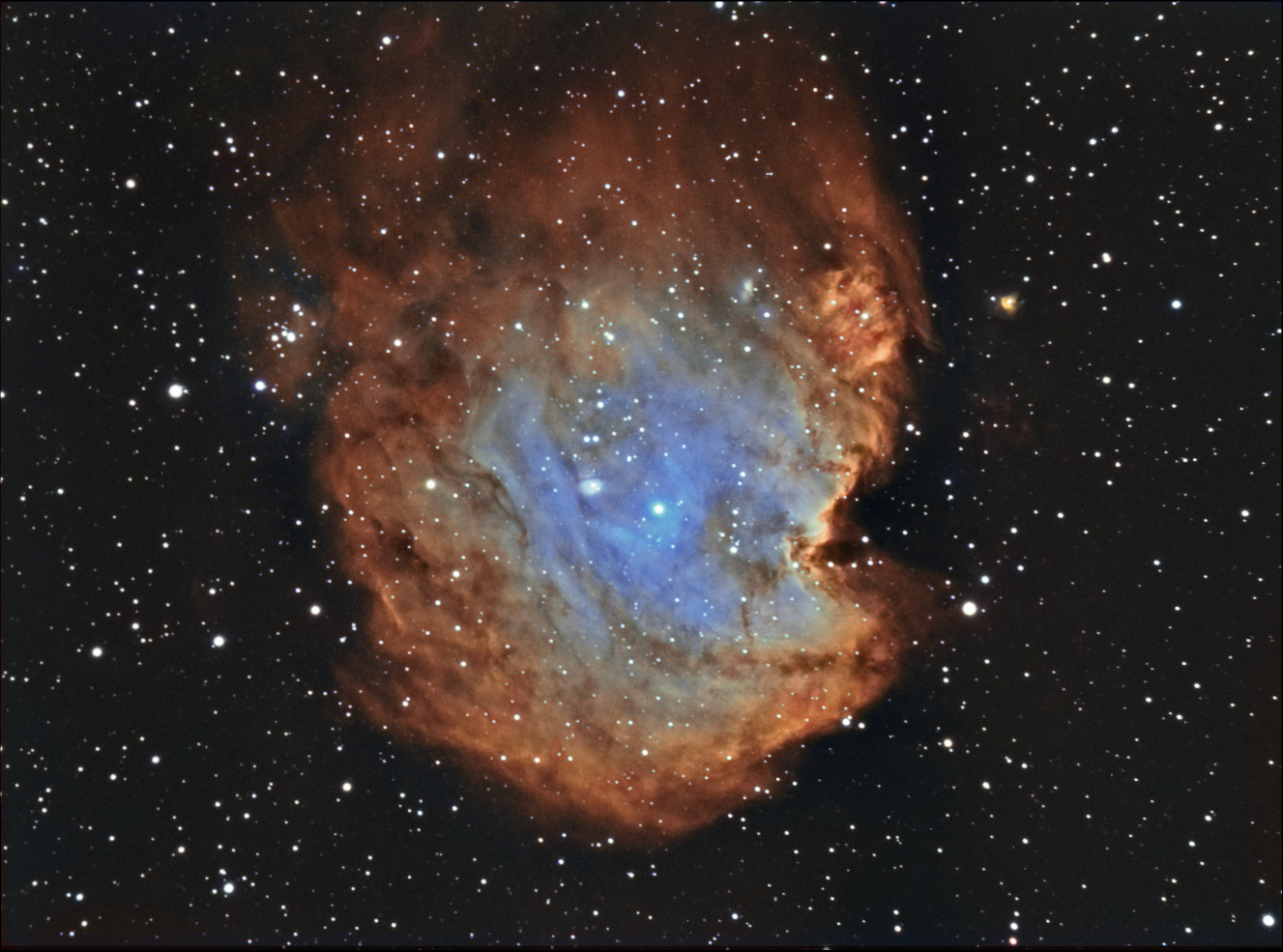
Here is also a crop of one edge of the nebula, I am happy with how this is coming along and am hoping with more data I will really get this region especially to "pop":

Imaging Camera: Atik 314L+
Imaging Scope: Orion EON80ED
Tracking & guiding scope: Celestron CPC800XLT
Guide Camera: Starlight XPress Lodestar
Filters: Astronomik Ha 12nm, Astronomik OIII 12nm
Location: fairly dark in the middle of nowhere Suffolk, England
Set temp on camera: -5C
Preprocessed & Stacked in Nebulosity
All post processing done in Photoshop CS2
Color to M51
Finally got another clear night and was able to grab 100 minutes each of RGB.
Here is the final (for now) LRGB version:


You can see it larger on My Flickr
First image in England and of 2011
Despite a lot of rain and clouds I have gotten a couple (literally, only 2 since we moved here in December) of clear nights to image. Using my new autoguider (Starlight XPress Lodestar) I am now able to get much longer exposures. I kept these at 10 min subs although I could have gone longer, but didn't want to push it too much my first time autoguiding. I still need a few more nights to get color data, but I am happy with how the Luminance has turned out so wanted to go ahead and post it.
This is 4 hrs of Luminance data, spread over two nights (total of 24 x 600s). Unfortunately I didn't orient the camera exactly the same for one hour the 2nd night (oops!!! At least I noticed then and was able to fix it for the rest of the session) so the edges don't have quite as much detail and depth, though the main portion is all 4 hrs.
Details:
Scope: Orion EON80ED piggybacked on Celestron CPC800
Cameras: Imaging - Atik 314L+, Guide - Starlight Xpress Lodestar
Filters: Astronomik Luminance
Location: Suffolk, England
Sub details: 24 x 600s, preprocessed with flats and darks
Software: Nebulosity (preprocessing and stacking), Photoshop CS2 (post-processing)
Full frame:

